
Reviewing AP Inter 2nd Year Botany Study Material Chapter 3 Molecular Basis of Inheritance Questions and Answers can help students prepare confidently for exams.
AP Inter 2nd Year Botany 3rd Lesson Molecular Basis of Inheritance Questions and Answers
IV. Very Short Answer Questions
Question 1.
Distinguish between heterochromatin and euchromatin. Which of the two is transcriptionally active?
Answer:
| Heterochromatin | Euchromatin |
| 1) Heterochromatin is tightly packed and stains dark is called Heterochromatin. | 1) Euchromatin is loosely packed and stains light is called Euchromatin. |
| 2) Heterochromatin is transcriptionally inactive. | 2) Euchromatin is transcriptionally active. |
Question 2.
Who proved that DNA is genetic material? On which organism they worked?
Answer:
- Alfred Hershey and Martha Chase demonstrated that DNA is the genetic material.
- They conducted their experiment using bacteriophages, which are viruses that infect bacteria.
Question 3.
What is the function of DNA polymerase?
Answer:
- DNA polymerase is a highly efficient enzyme that catalyses the polymerisation of a large number of nucleotides within a very short period.
- It also carries out the polymerisation process with a high level of accuracy.
Question 4.
What are the components of a nucleotide?
Answer:
A nucleotide consists of 3 components, nitrogen base, pentose sugar and phosphate group.
Question 5.
Given below is the sequence of coding strand of DNA in a transcription unit. 5′-AATGACGCCTATTAGG-3 ′. Write the sequence of
a) Its complementary strand
b) The mRNA
Answer:
a) 3 ‘TTACTGCGGATAATCC’ 5
b) 5 ‘AAUGACGCCUAUUAGG’ 3

Question 6.
Name any two viruses which have RNA as genetic material.
Answer:
- Influenza virus
- Polio virus
- HIV
Question 7.
What are the components of a transcriptional unit?
Answer:
The components of transcription unit are Promoter, structural gene, and terminator.
- A promoter,
- the structural gene, and
- A Terminator.
Question 8.
What is the difference between exons and introns?
Answer:
- Exons: These are the coding regions of a gene. They are retained in the mature (processed) RNA after RNA processing.
- Introns: These are the non-coding regions of a gene. They are removed during RNA processing and are absent in the mature (processed) RNA.
Question 9.
What is meant by capping and tailing?
Answer:
- Capping: The addition of a modified nucleotide, methylguanosine triphosphate (mwG), to the 52 end of hnRNA is known as capping.
- Tailing: The addition of 200 – 300 adenylate (poly-A) residues to the 32 end of hnRNA is called tailing.
Question 10.
What is meant by point mutation? Give an example.
Answer:
- A point mutation is a mutation that occurs due to a change in a single base pair of a DNA molecule.
- Example: Sickle cell anaemia.
Question 11.
What is meant by charging of tRNA?
Answer:
Charging of tRNA is the process in which an amino acid is activated in the presence of ATP and then attached to its corresponding (cognate) tRNA.
Question 12.
What is the function of the codon AUG? (AP MAY-22) (AP-20)
Answer:
AUG performs two important functions:
- It serves as the start (initiation) codon during protein synthesis.
- It specifies the amino acid methionine.
Question 13.
What do you understand ‘Stop codon’, and mention them. (AP MAR-15,19)
Answer:
- Stop codons are codons that signal the termination of protein synthesis.
- The three stop codons are UAA, UAG, and UGA.
- These codons do not specify any amino acid.
Question 14.
What is the difference between the template strand and a coding strand in a DNA molecule?
Answer:
- During transcription, the two strands of the DNA molecule separate from each other.
- The template strand serves as the complementary strand that guides the synthesis of mRNA.
The coding strand has the same nucleotide sequence as the mRNA (except that thymine is replaced by uracil in RNA) and does not directly serve as the template for transcription.
Question 15.
Write any two chemical differences between DNA and RNA.
Answer:
| DNA | RNA |
| 1) DNA has deoxyribose sugar. | 1) RNA has ribose sugar. |
| 2) DNA undergoes self-replication. | 2) RNA does not undergo self-replication. |
Question 16.
In a typical DNA molecule, the proportion of Thymine is 30%. Find out the percentage
Answer:
- Adenme =30%,
- Guanine = 20%,
- Cytosine = 20% (Total 70%).
Question 17.
The proportion of nucleotides in a given nucleic acid are: Adenine 18%, Guanine 30%, Cytosine 42%, and Uracil 10%. Name the nucleic acid and mention the number of strands in it.
Answer:
- It is RNA (presence of uracil)
- It is only single-stranded.
V. Short Answer Questions
Question 1.
Define transformation. Give a brief account of Griffith’s experiment,
Answer:
- Transformation: Transformation is the process in which a cell undergoes a genetic change by taking up and incorporating genetic material from its surroundings through the cell membrane.
- In 1928, Frederick Griffith performed a series of experiments on the bacterium Streptococcus pneumoniae, which causes pneumonia.
- During his study, he observed that the bacteria could change from one form to another when grown in a culture medium.
4. He identified two strains of the bacterium:
- Smooth strain (S-type) – forms smooth colonies due to the presence of a capsule.
- Rough strain (R-type) – lacks a capsule and forms rough colonies.
5. The S-type bacteria were disease-causing (virulent), whereas the R-type bacteria were harmless (non-virulent).
6. When living S-type cells were injected into mice, the mice developed pneumonia and died.
7. When living R-type cells were injected into mice, the mice remained healthy and survived.
8. Injection of heat-killed S-type cells did not cause disease in mice.
9. However, when heat-killed S-type cells were mixed with living R-type cells and injected into mice, the mice died, and living S-type bacteria were recovered from them
10. Griffith concluded that the living R-type bacteria had been converted into S-type bacteria by some substance released from the dead S-type cells.
11. He called this substance the transforming principle, which was later identified as DNA.
Question 2.
Discuss the significance of heavy isotope of nitrogen in Meselson and Stahl’s experiment?
Answer:
In 1958, Meselson and Stahl used the heavy nitrogen isotope 15N to demonstrate that DNA replication follows a semi-conservative mode.
1. Importance of 15N:
- Labelling DNA: E. coli bacteria were grown in a medium containing 15NH4Cl, allowing 15N to become incorporated into DNA, producing heavy DNA.
- Density Difference: Since 15N is heavier than 14N, DNA containing 15N could be easily distinguished from normal DNA based on density.
- Separation by Centrifugation: DNA samples were separated using CsCl density gradient centrifugation.
Heavy DNA (15N) formed a lower band.
Light DNA (14N) formed an upper band.
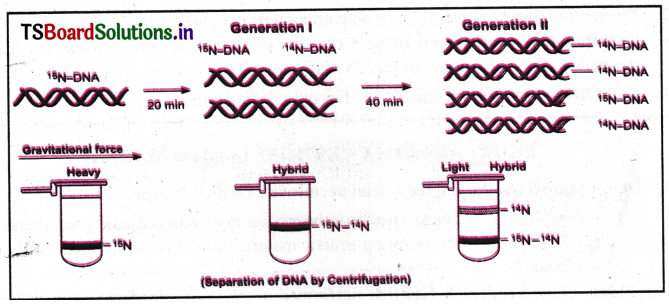
2. Tracking DNA Replication:
When bacteria were shifted to a medium containing 14N:
After one generation: Only hybrid DNA (intermediate density) was observed.
After two generations: Both hybrid DNA and light DNA were present in equal proportions. Proof of
Semi-Conservative Replication:
These observations proved that every newly formed DNA molecule contains:
- One parental strand (old strand) (15N)
- One newly synthesized strand (new strand) (14N). Thus, the use of 15N enabled scientists to trace DNA replication and provided the first experimental evidence for the semi-conservative replication of DNA.
Question 3.
How does t-RNA act as an adaptor molecule?
Answer:
t-RNA (transfer RNA), also known as soluble RNA (s-RNA), functions as an adaptor molecule because it connects the genetic information present in mRNA with the amino acids required for protein synthesis. This concept was proposed by Francis Crick.
How t-RNA Functions as an Adapter:
1. Two Functional Ends: t-RNA possesses two important binding regions:
- Anticodon loop – recognizes and binds to the complementary codon on mRNA.
- Amino acid acceptor end – attaches to a specific amino acid.
This enables t-RNA to link codons with their corresponding amino acids.
2. Specificity: Each type of t-RNA carries only a particular amino acid, ensuring accuracy during protein synthesis.
3. Charging (Aminoacylation): Before translation begins, amino acids are attached to their respective t-RNAs using ATP. This process is called charging of t-RNA or aminoacylation.
4. Structure: t-RNA has a cloverleaf-shaped secondary structure, while its three-dimensional structure resembles an inverted L-shape, which helps it function efficiently.
During Translation:
- The anticodon of t-RNA pairs with the codon on mRNA and delivers the correct amino acid to the ribosome.
- Thus, t-RNA serves as a bridge between mRNA codons and amino acids, ensuring proper synthesis of proteins.
Question 4.
How many types of RNA polymerases exist in eukaryotic cells? Write their names and functions.
Answer:
Eukaryotic cells contain three major RNA polymerases in the nucleus (apart from those present in organelles). They are:
- RNA Polymerase I: Responsible for the synthesis of rRNA molecules (28S, 18S, and 5.8S rRNA).
- RNA Polymerase II: Synthesizes hnRNA (heterogeneous nuclear RNA), the precursor of messenger RNA (mRNA).
- RNA Polymerase III: Carries out the transcription of tRNA, 5S rRNA, and snRNA (small nuclear RNA).
Question 5.
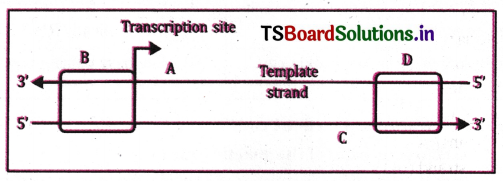
Identify the A, B, C, and D in the given picture.
Answer:
- A → Transcription Unit (Structural Gene): The DNA segment located between the initiation and termination signals where transcription takes place.
- B → Promoter: The DNA region where RNA polymerase binds to initiate transcription.
- C → Coding Strand (Non-template Strand): The DNA strand whose sequence is similar to the RNA transcript, except that thymine (T) is replaced by uracil (U) in RNA.
- D → Terminator: The DNA sequence that signals the end of transcription.
Question 6.
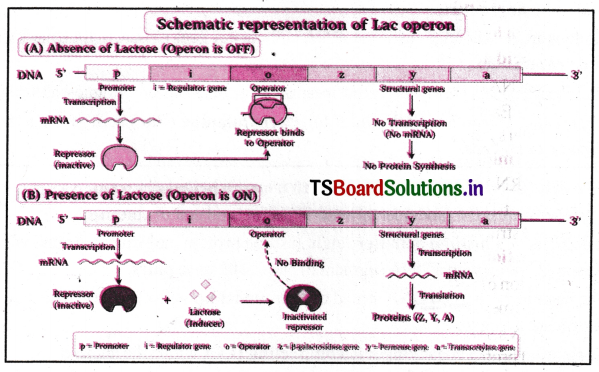
Draw the schematic representation of Lac operon.
Answer:
Question 7.
What are the differences between DNA and RNA?
Answer:
| DNA (Deoxyribonucleic Acid) | RNA (Ribonucleic Acid) |
| 1) Double-stranded helix structure. | 1) Usually single-stranded. |
| 2) Contains deoxyribose sugar. | 2) Contains ribose sugar. |
| 3) Nitrogen bases: A, T, Q C. | 3) Nitrogen bases: A, U, G, C. |
| 4) Thymine (T) present. | 4) Uracil (U) present instead of thymine. |
| 5) More stable chemically. | 5) Less stable compared to DNA. |
| 6) Mainly found in nucleus. | 6) Found in nucleus and cytoplasm. |
| 7) Function: Stores genetic information. | 7) Function: Helps in protein synthesis. |
| 8) Replicates itself. | 8) Does not self-replicate. |
| 9) Metabolically, DNA is of one type. | 9) Metabolically, RNA is of three types. |
| 10) The base pairing is A = T and G = C. | 10) The base pairing is A = U and G = C. |
Question 8.
Write the salient features of Genetic code? (AP Mar. 16,17, 24)
Answer:
The important characteristics of the genetic code:
- The genetic code is a collection of instructions that guides the conversion of genetic information into proteins containing 20 amino acids.
- It is made up of 64 nucleotide triplets, and each triplet is known as a codon.
- Out of the 64 codons, 61 codons specify amino acids, while 3 codons do not code for any amino acid and function as stop codons.
- Each codon specifies only one particular amino acid, making the genetic code unambiguous and specific.
- Some amino acids are represented by more than one codon; therefore, the genetic code is said to be degenerate.
- Codons are read continuously on mRNA without any gaps or punctuation marks, making the code comma-less.
- The genetic code is nearly universal, meaning it functions similarly in almost all living organisms.
- Example: The codon UUU codes for Phenylalanine (Phe) in organisms ranging from bacteria to humans.
Question 9.
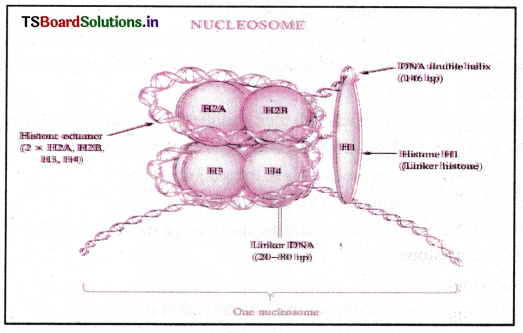
Give a brief account on nucleosome with a neat labelled diagram.
Answer:
- A nucleosome is the fundamental bead-like structural unit of chromatin.
- It consists of a histone octamer (eight histone protein molecules) around which DNA is wrapped, along with a DNA segment of about 200 base pairs.
- The negatively charged DNA strand coils around the positively charged histone octamer to form a nucleosome.
- Nucleosomes help in packing and compacting DNA within the nucleus.
- Chromatin is composed of DNA and basic histone proteins.
- Nucleosomes are arranged repeatedly along the chromatin fibre, forming its basic repeating units.
- Under an electron microscope, chromatin appears as a “beads-on-a-string” structure due to the presence of nucleosomes.
VI. Long Answer Questions
Question 1.
Give an account of post-transcriptional modifications of a eukaryotic mRNA.
Answer:
The primary transcript (hnRNA) undergoes several modifications after transcription inside the nucleus before becoming mature mRNA.
5′ Capping:
- The first modification is the addition of a 7-methylguanosine cap at the 5′ end of hnRNA through an unusual 5′ – 5′ triphosphate linkage.
- Extra methyl groups may also be added to the cap structure.
- The cap protects mRNA from degradation, helps in its stability, and assists in the initiation of translation.
2. Addition of Poly-A Tail:
- A long chain of about 40-200 adenine nucleotides is added to the 3′ end of mRNA.
- This structure is called the Poly-A tail.
- It is added after transcription and is not directly coded by DNA.
- The Poly-A tail improves mRNA stability and helps in its transport from the nucleus to the cytoplasm.
- As mRNA ages in the cytoplasm, the Poly-A tail gradually becomes shorter.
3. Splicing (Removal of Introns):
- Eukaryotic hnRNA contains both coding and non-coding sequences.
- The non-coding regions called introns are removed.
- The coding regions called exons are joined together to form mature mRNA.
- After these modifications, the mature mRNA leaves the nucleus and participates in protein synthesis.
Question 2.
Discuss the process of translation in detail.
Answer:
Translation is the process by which amino acids are linked together according to the sequence of codons in mRNA to form a polypeptide chain. The process occurs in three stages:
1. Initiation:
- Amino acids are first attached to their specific tRNAs using ATP (charging of tRNA).
- The start codon AUG on mRNA is recognized by the charged initiator tRNA.
- The ribosome acts as the site where translation occurs.
- It contains two binding sites for tRNA molecules.
- The small ribosomal subunit binds to mRNA at the start codon, followed by the attachment of the large subunit.
2. Elongation:
- The ribosome moves along the mRNA one codon at a time.
- Each incoming amino acid carried by tRNA is joined to the growing polypeptide chain by a peptide bond.
- This step continues repeatedly, resulting in the elongation of the protein chain.
3. Termination:
- Translation stops when the ribosome reaches a stop codon (UAA, UAG, or UGA).
- The completed polypeptide is released, and the ribosomal subunits detach from the mRNA.
Question 3.
Give the salient features of the Double helix structure of DNA.
Answer:
The Double Helix Model of DNA was proposed by Watson and Crick
1. DNA consists of two polynucleotide strands. Each strand has a sugar-phosphate backbone on the outside and nitrogenous bases projecting inward.
2. The two strands run in opposite directions (anti-parallel). If one strand runs 5′ → 3′, the other runs 3′ → 5′.
3. The nitrogenous bases pair through hydrogen bonds:
- Adenine (A) pairs with Thymine (T) by two hydrogen bonds.
- Guanine (G) pairs with Cytosine
- by three hydrogen bonds. This complementary pairing maintains a constant diameter of about 20 Å throughout the helix.
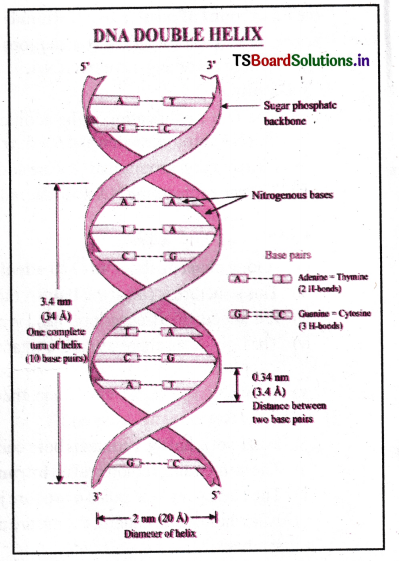
4. DNA is a right-handed helix. One complete turn measures 3.4 nm and contains about 10 base pairs. The distance between two adjacent base pairs is 0.34 nm.
5. The base pairs are stacked one above another, which provides additional stability to the DNA molecule along with hydrogen bonding.
Question 4.
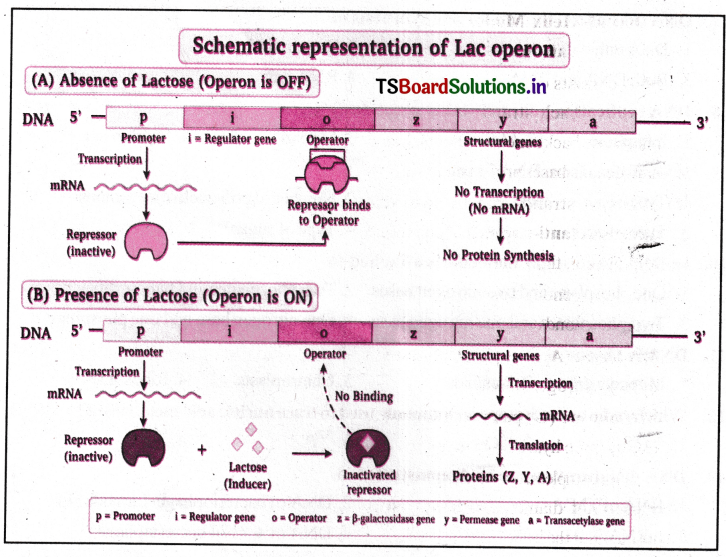
Describe the Lac operon with schematic representation.
Answer:
- The Lac operon is a group of regulatory and structural genes that function together to control the metabolism of lactose in bacteria.
- It consists of important regions such as the regulator gene (i), promoter (P), operator (O), and three structural genes: Z, Y, and A.
- The operon enables the utilization of lactose by converting it into simpler sugars like glucose and galactose.
- In the Lac operon, lactose acts as an inducer.
- When lactose is present, it binds to the repressor protein and makes it inactive. RNA polymerase can then bind to the promoter and begin transcription.
- As a result, the structural genes Z, Y, and A are expressed and produce their respective enzymes.
- These enzymes help in the breakdown and utilization of lactose. When lactose levels decrease, the repressor protein is produced again.
- The active repressor binds to the operator region and blocks RNA polymerase from transcribing the operon. Therefore, transcription stops in the absence of the inducer.
Schematic representation of the Lac operon
I. Multiple Choice Questions
Question 1.
Which among the following is not true?
1. Bacteriophage Φ × 174 has 5386 nucleotides.
2. Bacteriophage lambda has 48502 bp.
3. Escherichiacolihas 4.6 × 10⁶ bp.
4. Haploid content of human DNA is 6.6 × 10⁹ bp.
Answer:
4. Haploid content of human DNA is 6.6 × 10⁹ bp.
Question 2.
As per the Watson and Crick DNA model, the pitch length of the DNA double helix is
1. 0.34 nm
2. 3.4 nm
3. 3.4 Å
4. 0.34 Å
Answer:
2. 3.4 nm
Question 3.
Which of the following nitrogen base is absent in RNA?
1. Adenine
2. Cytosine
3. Uracil
4. Thymine
Answer:
4. Thymine
Question 4.
Approximate length of a typical mammalian cell DNA is
1. 2.6 meters
2. 2 meters
3. 2.2 metres
4. 2.4 meters
Answer:
3. 2.2 metres
Question 5.
A molecule should not have one of the following features to act as a genetic material
1. It should be able to generate its replica (Replication).
2. It should be stable chemically and structurally.
3. It should provide the scope for rapid changes that are required for evolution.
4. It should be able to express itself in the form of‘Mendelian Characters’.
Answer:
3. It should provide the scope for rapid changes that are required for evolution.
Question 6.
DNA fragments can be joined by the following enzyme.
1. DNA polymerase
2. DNA Ligase
3. DNase
4. DNA-dependent RNA polymerase
Answer:
2. DNA Ligase
Question 7.
During the transcription RNA Polymerase binds to the following region of transcriptional unit.
1. Terminator
2. Structural gene
3. Promoter
4. Operator
Answer:
3. Promoter
Question 8.
What is the role of RNA polymerase III in the process of transcription in Eukaryotes?
1. Transcription of tRNA, 5 s rRNA, and snRNA
2. Transcription of precursor of mRNA
3. Transcription of only snRNAs
4. Transcription of rRNAs(28S, 18S and 5.8S)
Answer:
1. Transcription of tRNA, 5 s rRNA, and snRNA
Question 9.
‘Operon’concept was proposed by
1. Meselson and Stahl
2. Watson and Crick
3. Jacob and Monod
4. Har Gobind Khorana
Answer:
3. Jacob and Monod
Question 10.
Enzyme permease is synthesized by
1. z-gene
2. a-gene
3. i-gene
4. y-gene
Answer:
4. y-gene
II. Fill in the Blanks
1. DNA is a polymer of ………………………………….. .
Answer:
Deoxyribonucleotides.
2. Cytosine, Uracil …………………………. and are together called Pyrimidines.
Answer:
Thymine.
3. DNA was first identified by Friedrich Miescher, and he named it as ………………………….. .
Answer:
Nuclein
4. James Watson and Francis Crick …………………………… proposed model of DNA.
Answer:
Double Helix
5. Discontinuous synthesis of DNA takes place on ……………………………. parental strand of DNA.
Answer:
5’→ 3′
6. ……………………………… is loosely packed and transcriptionally active chromatin.
Answer:
Euchromatin
7. The average rate of polymerisation by DNA polymerase enzyme in E.coli is approximately …………………. per second.
Answer:
2000 bp
8. In bacterial cells, with the help of ………………………….. factor, RNA polymerase initiates transcription.
Answer:
Sigma or σ
9. During transcription, ……………………… enzyme plays a key role in DNA helix unwinding.
Answer:
RNA polymerase
10. Copying of genetic information from one strand of the DNA into RNA is termed as …………………. .
Answer:
transcription
III. One Word Answer Questions
Question 1.
Name the pyrimidine which is common in both DNA and RNA.
Answer:
Cytosine
Question 2.
Which feature of DNA molecule enables the constant distance between two strands?
Answer:
Purine and pyrimidine base pairing.
Question 3.
Who proposed central dogma in molecular biology?
Answer:
Francis Crick.
Question 4.
Write the names of basic amino acids which are rich in histone proteins.
Answer:
Lysine and arginine
Question 5.
At what specific region, DNA replication initiates?
Answer:
‘Ori’region
Question 6.
Name the bacteria which is used by Griffith for conducting transformation experiments.
Answer:
Streptococcus pneumoniae
Question 7.
Normal E. coli was allowed to grow in a medium containing 15NH4Cl for 80 minutes; then what would be the proportions of light, hybrid, and heavy density DNA molecules?
Answer:
0: 2: 14
Question 8.
In which direction does the DNA polymerase enzyme polymerises the DNA.
Answer:
5′ → 3′
Question 9.
Write the name of Severo Ochoa enzyme.
Answer:
Polynucleotide phosphorylase
Question 10.
Who first proposed that the‘codon’is a triplet?
Answer:
George Gamow
Objective Questions
Question 1.
The basic building blocks of nucleic acids are known as
1. Nitrogen bases
2. Nucleotides
3. Pentose monosaccharides
4. Nucleosides
Answer:
2. Nucleotides
Question 2.
The genetic molecule found most abundantly in living organisms is
1. RNA
2. tRNA
3. DNA
4. mRNA
Answer:
3. DNA
Question 3.
The repeating units that make up nucleic acid chains are called
1. Nucleosides
2. Heterocyclic molecules
3. Nucleotides
4. Pentose sugars
Answer:
3. Nucleotides
Question 4.
The principal genetic material in most organisms is
1. mRNA
2. DNA
3. rRNA
4. RNA
Answer:
3. rRNA
Question 5.
DNA molecule carries a
1. Positive charge
2. No charge
3. Negative charge
4. Positive charge only during denaturation
Answer:
3. Negative charge
Question 6.
Another name for thymine is
1. Thymidylic acid
2. 5-methyluracil
3. Uridine
4. Thymidine
Answer:
2. 5-methyluracil
Question 7.
DNA acts as a template for the synthesis of
1. DNA only
2. Proteins only
3. Both DNA and RNA
4. RNA only
Answer:
3. Both DNA and RNA
Question 8.
DNA replication generally takes place during
1. Interphase
2. Meiosis
3. Mitosis
4. Interkinesis
Answer:
1. Interphase
Question 9.
RNA differs from DNA in the
1. Type of pyrimidines
2. Number of polynucleotide strands
3. Type of purines
4. Type of sugar
Answer:
3. Type of purines
Question 10.
In DNA, each sugar molecule is attached to
1. One phosphate and two nitrogen bases
2. Two phosphates and two nitrogen bases
3. Two phosphates and one nitrogen base
4. One nitrogen base and one phosphate
Answer:
3. Two phosphates and one nitrogen base
Question 11.
DNA is absent in
1. Mitochondria
2. Plasmids
3. Chloroplasts
4. Ribosomes
Answer:
4. Ribosomes
Question 14.
Which statement correctly describes a property of DNA?
1. It should evolve rapidly
2. It should be biochemically unstable
3. It should mutate very quickly
4. It should be able to replicate
Answer:
4. It should be able to replicate
Question 15.
In eukaryotes, one mRNA molecule is generally produced from
1. Three structural genes
2. A single structural gene
3. Many structural genes
4. Two structural genes
Answer:
2. A single structural gene
Question 16.
The approximate time required for DNA replication in E. coli is
1. 20 minutes
2. 40 minutes
3. 18 minutes
4. 80 minutes
Answer:
3. 18 minutes
Question 17.
The total length of DNA present in a typical human cell is about
1. 4.2 metres
2. 3.2 metres
3. 1.2 metres
4. 2 metres
Answer:
4. 2 metres
Question 18.
DNA strands are described as antiparallel because of
1. Peptide bonds
2. Hydrogen bonds
3. Phosphodiester bonds
4. Disulphide bonds
Answer:
2. Hydrogen bonds
Question 19.
One complete turn of B-form DNA measures nearly
1. 2.0 nm
2. 20 nm
3. 3.4 nm
4. 0.34 nm
Answer:
3. 3.4 nm
Question 20.
The transfer of genetic information from DNA into RNA is called
1. Polyadenylation
2. Transformation
3. Transcription
4. Translation
Answer:
3. Transcription
Question 21.
During transcription, the DNA strand that is copied is called
1. Coding strand
2. Terminator strand
3. Template strand
4. Promoter strand
Answer:
1. Coding strand
Question 22.
The DNA strand not directly used in RNA synthesis is known as
1. Template strand
2. Coding strand
3. Antisense strand
4. Complementary strand
Answer:
2. Coding strand
Question 23.
In bacteria, transcription and translation occur respectively in
1. Cytoplasm and cytoplasm
2. Nucleus and cytoplasm
3. Cytoplasm and genephore
4. Nucleoid and nucleus
Answer:
1. Cytoplasm and cytoplasm
Question 24.
Identify the incorrect match.
1. mRNA-template for protein synthesis
2. tRNA-reader of genetic code
3. rRNA – catalytic role in translation
4. Transcription – DNA-dependent DNA polymerase
Answer:
4. Transcription – DNA-dependent DNA polymerase
Question 25.
The primary transcript is longer than functional hnRNA in
1. Prokaryotic animals
2. Cyanobacteria
3. Eukaryotes
4. Prokaryotes
Answer:
3. Eukaryotes
Question 26.
Transcription of snRNA is carried out by
1. RNA polymerase II
2. RNA polymerase III
3. RNA polymerase I
4. RNA polymerase I & II
Answer:
2. RNA polymerase III
Question 27.
Introns are commonly found in
1. Eukaryotes only
2. Both prokaryotes and eukaryotes
3. Bacteria only
4. Prokaryotes only
Answer:
1. Eukaryotes only
Question 28.
Exons are present in
1. Only in prokaryotes
2. Only in eukaryotic plants
3. Both prokaryotes and eukaryotes
4. Only in eukaryotes
Answer:
4. Only in eukaryotes
Question 29.
Split genes are characteristic of
1. Cyanobacteria
2. Bacteria
3. All Monerans
4. Eukaryotes
Answer:
4. Eukaryotes
Question 30.
Genes are primarily made up of
1. Glycoproteins
2. Histone proteins
3. Polynucleotides
4. Lipoproteins
Answer:
3. Polynucleotides
Question 31.
The synthesis of repressor mRNA is controlled by
1. ‘i’ gene
2. ‘Y’ gene
3. ‘Z’ gene
4. ‘O’ gene
Answer:
1. ‘i’ gene
Question 32.
The total number of nucleotides present in bacteriophage lambda DNA is
1. 97040
2. 48520
3. 48502
4. 97004
Answer:
3. 48502
Question 33.
The transcriptionally active form of chromatin is called
1. Heterochromatin
2. Euchromatin
3. Chromatogram
4. Prochromatin
Answer:
2. Euchromatin
Question 34.
DNA is composed of which of the following?
A) Sugar
B) Phosphate
C) Purines
D) Pyrimidines
1. A, B and C only
2. A and C only
3. A, B, C and D
4. A and D only
Answer:
3. A, B, C and D
Question 35.
A nucleoside differs from a nucleotide by
1. Presence of phosphate group
2. Absence of phosphate group
3. Absence of sugar
4. Absence of nitrogen base
Answer:
2. Absence of phosphate group
Question 36.
The earliest proof that DNA acts as the genetic material came from
1. Phage infection
2. Bacterial transformation
3. Bacterial translocation
4. Transfection
Answer:
1. Phage infection
Question 37.
Griffith conducted his transformation experiment using
1. Streptococcus pyogenes
2. Escherichia coli
3. Streptococcus pneumoniae
4. Streptomyces griseus
Answer:
3. Streptococcus pneumoniae
Question 38.
Avery, MacLeod, and McCarty identified …………………….. as the transforming principle.
1. Proteins
2. Polysaccharides
3. DNA
4. RNA
Answer:
3. DNA
Question 39.
Around each histone core, DNA wraps approximately
1. Two turns
2. Five turns
3. Three turns
4. Four turns
Answer:
1. Two turns
Question 40.
Uracil differs from thymine because it
1. Has a methyl group
2. Has two C-N rings
3. Contains an NH2 group
4. Lacks a methyl group
Answer:
4. Lacks a methyl group
Question 41.
The haploid DNA content in humans is approximately
1. 48502 bp
2. 5386 nucleotides
3. 3.3 × 10⁹ bp
4. 4.6 × 10⁶ bp
Answer:
3. 3.3 × 10⁹ bp
Question 42.
A nucleotide is composed of
1. Sugar + Phosphate
2. Base + Sugar
3. Base + Phosphate
4. Base + Sugar + Phosphate
Answer:
2. Base + Sugar
Question 43.
Which of the following is NOT a property of genetic material?
1. Self-replication
2. Chemical and structural stability
3. Fast mutation
4. Self-expression
Answer:
3. Fast mutation
Question 44.
Which statement is NOT a characteristic of RNA?
1. RNA evolves slowly
2. RNA is unstable and degradable
3. RNA can act as a catalyst
4. RNA mutates faster than DNA
Answer:
1. RNA evolves slowly
Question 45.
In the Hershey and Chase experiment, radioactive 35 S labelled
1. Cytosol of bacteria
2. Phage DNA
3. Protein coat of bacteriophage
4. Bacterial DNA
Answer:
3. Protein coat of bacteriophage
Question 46.
A cluster of closely associated structural and regulatory genes functioning together is called
1. Genetic code
2. Operon
3. Monocistronic gene
4. Regulon
Answer:
2. Operon
Question 47.
Heterogeneous nuclear RNA (hnRNA) is converted into mRNA through
1. Splicing only
2. Capping only
3. Tailing only
4. All of the above
Answer:
4. All of the above
Question 48.
The number of sense codons coding for amino acids is
1. 60
2. 64
3. 61
4. 32
Answer:
3. 61
Question 49.
Identify the correct statement.
1. ACG codes for Asparagine
2. UGU codes for Tyrosine
3. CGA codes for Serine
4. GUA codes for Valine
Answer:
4. GUA codes for Valine
Question 50.
Which of the following is NOT a feature of the genetic code?
1. It is degenerate
2. It is nearly universal
3. It is non-continuous
4. It is unambiguous
Answer:
3. It is non-continuous
Question 51.
The functional unit of a gene is known as
1. Muton
2. Cistron
3. Intron
4. Recon
Answer:
2. Cistron
Question 52.
Mature (processed) mRNA contains
1. Exons only
2. Introns only
3. Exons and introns
4. Capping at 3′ end
Answer:
1. Exons only
Question 53.
The RNA molecule that performs both structural and catalytic functions during translation is
1. tRNA
2. rRNA
3. sRNA
4. mRNA
Answer:
2. rRNA
Question 54.
Ochoa’s enzyme refers to
1. DNA polymerase
2. Polynucleotide phosphorylase
3. Peptidyl transferase
4. DNA ligase
Answer:
3. Peptidyl transferase
Question 55.
The gene responsible for producing the repressor protein is
1. Promoter gene
2. Structural gene
3. Regulator gene
4. Operator gene
Answer:
3. Regulator gene
Question 56.
The attachment site for the repressor protein produced by the regulator gene is the
1. Structural gene
2. Promoter region
3. Operator gene
4. Inducer
Answer:
3. Operator gene
Question 57.
The rule stating that in DNA the amount of adenine equals thymine and guanine equals cytosine is called
1. Jordan’s rule
2. Chargaff’s rule
3. Aflen’s rule
4. Stahl’s rule
Answer:
2. Chargaff’s rule
Question 58.
Purines are chemically classified as
1. Monocycic
2. Dicyclic and heterocyclic
3. Homocycic
4. Dicyclic and homocyclic
Answer:
2. Dicyclic and heterocyclic
Question 59.
A phosphate group is attached to the 5′-OH of a nucleotide through
1. Glycosidic linkage
2. Hydrogen linkage
3. Phosphoester linkage
4. Both (1) & (2)
Answer:
3. Phosphoester linkage
Question 60.
In the Lac operon, the inducer combines with
1. Promoter gene
2. Repressor protein
3. Repressor gene
4. Operator gene
Answer:
2. Repressor protein