
Reviewing AP Inter 2nd Year Botany Study Material Chapter 2 Principles of Inheritance and Variation Questions and Answers can help students prepare confidently for exams.
AP Inter 2nd Year Botany 2nd Lesson Principles of Inheritance and Variation Questions and Answers
IV. Very Short Answer Questions
Question 1.
What is the cross between the F1 progeny and a homozygous recessive parent called? How is it useful?
Answer:
- Such a cross is known as a Test Cross.
- It is used to identify the genotype of the organism being tested.
Question 2.
Do you think Mendel’s laws of inheritance would have been different if the characters he chosen were located on the same chromosome?
Answer:
Yes. If the genes for different characters were present on the same chromosome, they would tend to be inherited together and would not follow Mendel’s Law of Independent Assortment
Question 3.
Who proposed the chromosome theory of inheritance? [AP MAR-17,19]
Answer:
Sutton and Boveri.
Question 4.
Define true breeding and mention its significance.
Answer:
- True Breeding: Continuous self-pollination over generations, resulting in offspring with the same traits, is called true breeding.
- Significance: It ensures the stable inheritance and expression of traits through many generations.
Question 5.
Explain the terms phenotype and genotype. [AP MAR-16,23,24]
Answer:
- The observable physical appearance of an organism is called its Phenotype.
- The genetic constitution of an organism is called its Genotype.
Question 6.
What is linkage?
Answer:
Linkage is the tendency of genes located on the same chromosome to remain associated and get inherited together.

Question 7.
What will be the phenotypic ratio in the offspring obtained from the following crosses?
a) AA x aa
b) Aa x Aa
Note: Gene A is dominant over gene a.
Answer:
a) 1: 1
b) 3: 1.
Question 8.
In garden peas, the gene T for tall is dominant over its allele for dwarf. Give the genotypes of the parents in the following crosses.
a) Tall × Dwarf producing all tall plants.
b) Tall × dwarf producing half tall and half dwarf.
Answer:
(a) Tall x Dwarf → All tall plants: To obtain all tall offspring, the tall parent must be homozygous dominant (TT) and the dwarf parent must be homozygous recessive (tt). Genotypes: TT × tt
(b) Tall × Dwarf → Half tall and half dwarf (1:1 ratio): This ratio is obtained when the tall parent is heterozygous (Tt) and the dwarf parent is tt. Genotypes: Tt x tt
V. Short Answer Questions
Question 1.
Differentiate between the following
A) Dominant and Recessive B) Homozygous and Heterozygous
Answer:
A)
| Dominant | Recessive |
| 1) Expressed even when only one allele is present (Tt). | 1) Expressed only when both alleles are recessive (tt). |
| 2) Masks the effect of the recessive allele. | 2) Gets masked in the presence of a dominant allele. |
| 3) Represented by capital letters (e.g., T). | 3) Represented by small letters (e.g., t). |
| 4) Appears in F1 generation. | 4) Usually hidden in F1; appears in F2 generation. |
B)
| Homozygous | Heterozygous |
| Contains identical alleles (TT or tt). | Contains different alleles (Tt). |
| Produces only one type of gamete. | Produces two types of gametes. |
| Also called purebred. | Not a purebred. |
| Expression depends on allele type (dominant or recessive). | Shows dominant trait in most cases. |
Question 2.
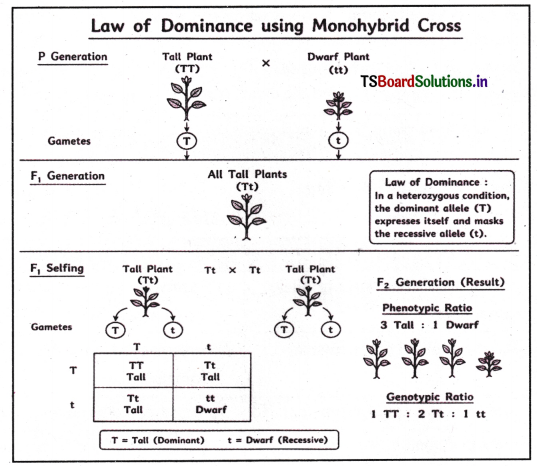
Explain the law of dominance using a monohybrid cross.
Answer:
Monohybrid Cross:
- A cross involving two individuals differing in one pair of contrasting characters is called a monohybrid cross.
- In his experiments, Mendel crossed tall and dwarf pea plants to study the inheritance of a single trait. Based on these observations, he proposed the Law of Dominance.
Law of Dominance:
- Characters are controlled by discrete hereditary units called factors.
- Factors occur in pairs.
- When two contrasting factors are present together, one factor (dominant) expresses itself, while the other (recessive) remains hidden.
- This law explains why only one parental trait appears in the F1 generation and why both traits reappear in the F2 generation. It also explains the 3:1 phenotypic ratio obtained in F2.
Question 3.
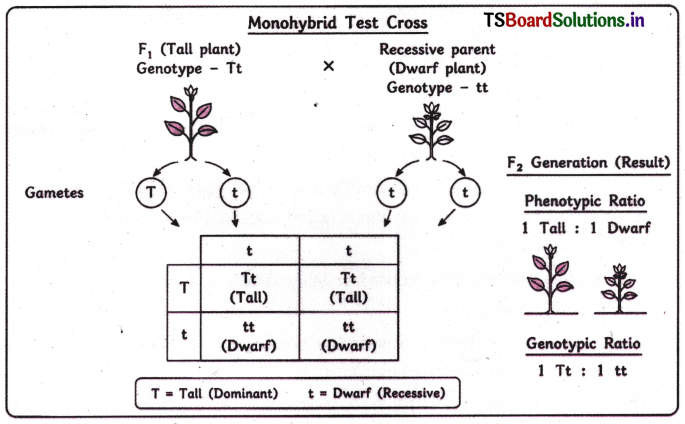
Define and describe a test cross. [AP MAR-25,16]
Answer:
- A test cross is the crossing of an F1 individual with a recessive parent.
- It is used to determine whether an individual is homozygous or heterozygous.
- A monohybrid test cross produces a 1:1 phenotypic ratio.
- A dihybrid test cross produces a ratio.
Question 4.
Explain incomplete dominance with examples.
Answer:
Incomplete Dominance:
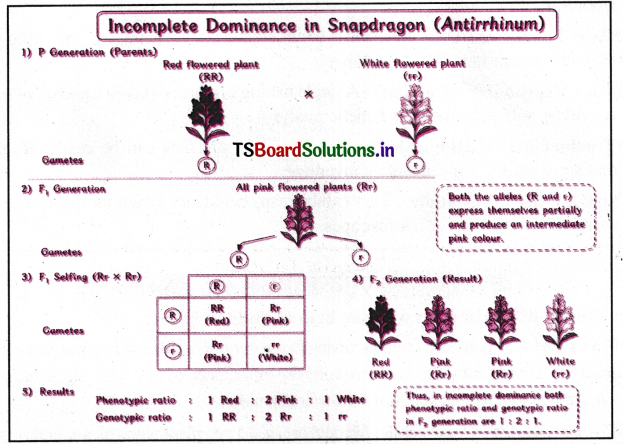
- Incomplete dominance is a condition in which neither allele is completely dominant nor completely recessive.
- A common example is the inheritance of flower colour in Snapdragon (Antirrhinum).
- When a red-flowered plant (RR) is crossed with a white-flowered plant (rr), all F1 plants (Rr) show pink flowers.
- When the F1 plants are self-pollinated, the F2 generation shows: 1 (RR) Red, 2 (Rr) Pink, 1 (rr) White.
- The genotypic ratio remains 1:2:1, similar to Mendel’s monohybrid cross.
- However, the phenotypic ratio also becomes 1:2:1 because neither allele completely dominates the other.
- Thus, in incomplete dominance, both phenotypic and genotypic ratios in the F2 generation are 1:2:1.
Question 5.
Define the law of segregation and the law of independent assortment.
Answer:
a) Law of Segregation:
- The two alleles of a gene remain separate and do not blend when present together in a heterozygous condition.
- During meiosis, these alleles separate so that each gamete receives only one allele.
- This law is based on the results of monohybrid crosses.
- It was proposed by Mendel.
- It is also called the Law of Purity of Gametes.
b) Law of Independent Assortment:
- When two or more pairs of contrasting traits are considered, the inheritance of one pair of factors is independent of the other pair.
- This law is based on the results of dihybrid crosses.
- It was proposed by Mendel as his Second Law.
Question 6.
Why did T.H. Morgan select fruit flies for his genetical experiments?
Answer:
Thomas Hunt Morgan selected the fruit fly, Drosophila melanogaster, for genetic studies because of several advantages:
- Easy Cultivation: They can be easily reared on a simple synthetic medium under laboratory conditions.
- Short Life Cycle: Their life cycle is completed in about two weeks, allowing the study of many generations in a short time.
- High Reproductive Capacity: A single mating produces a large number of offspring, providing sufficient data for genetic analysis.
- Distinct Sexual Dimorphism: Male and female flies can be easily distinguished, making breeding experiments convenient.
- Visible Genetic Variations: They exhibit many hereditary variations that can be observed easily under low-power microscopes.
VI. Long Answer Questions
Question 1.
Explain the dihybrid cross with the help of Punnett square.
Answer:
A dihybrid cross is a genetic cross involving two parents that differ in two pairs of contrasting characters. Mendel used this cross to study the inheritance of two traits at the same time and concluded that different pairs of traits assort independently.
1. The Parental (P) Generation: Mendel crossed a pea plant with round, yellow seeds and a pea plant with wrinkled, green seeds.
- Genotypes: Round, yellow parent – RRYY; wrinkled, green parent = rryy
- Dominance: Yellow seed colour (Y) is dominant over green (y). Round seed shape (R) is dominant over wrinkled (r).
- Gamete: RRYY parent produces RY gametes; rryy parent produces ry gametes.
2. The F Generation: After fertilization, the offspring produced have the genotype. RrYy Phenotype: All F plants are round and yellow because dominant alleles mask the recessive alleles.
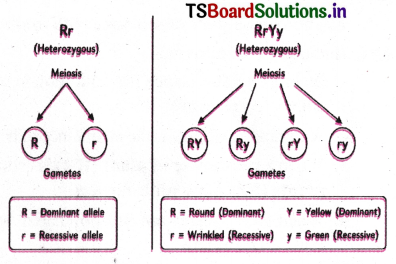
3. Gamete Formation and Independent Assortment: When F plants are self-pollinated, they produce four kinds of gametes. According to the Law of Independent Assortment, segregation of R and r occurs independently of Y and y. The four types of gametes are: RY, Ry, rY, ry. Each type is formed in equal proportion (25% or 1/4).
4. The F Punnett Square: A Punnett square is a diagram used to predict all possible combinations of offspring. For a dihybrid cross, a 16-square Punnett grid is used because four types of male gametes combine with four types of female gametes.
Punnett Square (F, Generation)
| RY | Ry | rY | ry | |
| RY | RRYY | RRYy | RrYY | RrYy |
| Ry | RRYy | RRyy | RrYy | Rryy |
| rY | RrYY | RrYy | rrYY | rrYy |
| ry | RrYy | Rryy | rrYy | rryy |
5. Results of the Cross: Analysis of the sixteen combinations in the F1 generation gives: Phenotypic Ratio: 9 : 3 : 3: 1
- 9 Round, Yellow (Parental type)
- 3 Round, Green (Recombinant)
- 3 Wrinkled, Yellow (Recombinant)
- 1 Wrinkled, Green (Parental type)
Genotypic Ratio: 1 : 2 : 1: 2 : 4 : 2 : 1 : 2 : 1
Conclusion: Law of Independent Assortment: Based on the results of the dihybrid cross, Mendel proposed the Law of Independent Assortment, which states that: “When two pairs of traits are inherited together, the segregation of one pair of factors is independent of the segregation of the other pair”. This means that inheritance of one trait (such as seed shape) does not influence the inheritance of another trait (such as seed colour).
Question 2.
Write notes on chromosomal theory of inheritance?
Answer:
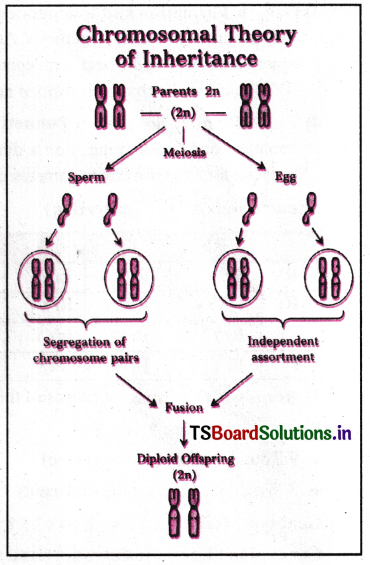
The Chromosomal Theory of Inheritance was proposed by Walter Sutton and Theodor Boveri. According to this theory, genes are located on chromosomes, and chromosomes are responsible for transmitting hereditary characters from parents to offspring.
1. Main Principles:
- Genes are arranged in a linear sequence on chromosomes.
- Chromosomes occur in homologous pairs in diploid organisms, with one chromosome of each pair inherited from each parent.
- During meiosis, homologous chromosomes separate, causing alleles to segregate. This provides an explanation for Mendel’s Law of Segregation.
- Different chromosome pairs assort independently during meiosis. This explains Mendel’s Law of Independent Assortment.
- During fertilization, male and female gametes fuse, restoring the diploid chromosome number in the zygote.
2. Observations of Sutton and Boveri :
They observed that chromosomes:
- Occur in pairs during meiosis.
- Separate and move into different gametes. This behaviour closely resembles that of Mendel’s hereditary factors (genes). Therefore, they concluded that chromosomes carry genes and control inheritance.
3. Experimental Evidence: The theory was later supported by Thomas Hunt Morgan through his experiments on Drosophila melanogaster. He discovered:
- Linkage: Genes present on the same chromosome tend to be inherited together.
- This demonstrated that all genes do not assort independently.
4. Extension of the Theory:
- Not all genes follow independent assortment.
- Genes present on the same chromosome exhibit linkage.
- Crossing over during meiosis produces recombination.
5. Significance:
- Provides the physical (cytological) basis of inheritance.
- Establishes a connection between cytology and genetics.
- Provides scientific support for Mendel’s laws.
- Helps in understanding genetic variation and evolution.
Conclusion: The chromosomal theory states that genes are located on chromosomes, and their inheritance follows chromosome behaviour during meiosis and fertilization, thereby explaining how traits are transmitted from parents to offspring.
Question 3.
Explain the following
a) Law of dominance
b) Incomplete dominance
Answer:
Monohybrid Cross:
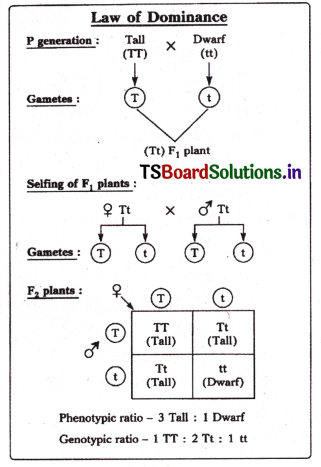
- A cross between two individuals differing in one contrasting character is called a monohybrid cross.
- In his hybridization experiments, Mendel crossed tall and dwarf pea plants to study the inheritance of a single gene. From these observations, he proposed the Law of Dominance.
a) Law of Dominance:
- Characters are controlled bý discrete hereditary units called factors.
- Factors occur in pairs.
- When two contrasting factors are present together, one factor (dominant) expresses itself while the other (recessive) remains hidden.
- The law explains why only one parental character appears in the F generation and why both parental characters reappear in the F1 generation. It also explains the 3:1 phenotypic ratio observed in F2.
b) Incomplete dominance
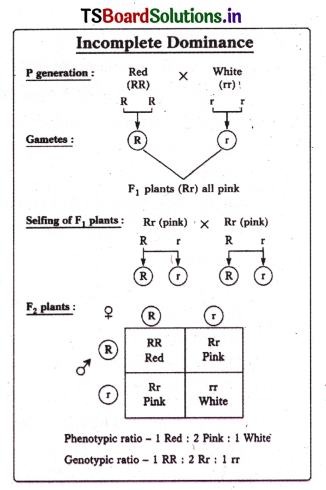
- Incomplete dominance is a phenomenon in which neither allele is completely dominant nor completely recessive.
- Example: Flower colour inheritance in Snapdragon (Antirrhinum).
- When a homozygous red-flowered plant (RR) is crossed with a homozygous white-flowered plant (rr), all F1 plants (Rr) show pink flowers.
- On self-pollination of F1 plants, the F2 generation shows:
1(RR) Red
2(Rr) Pink
1(rr) White
5. The genotypic ratio remains the same as Mendel’s monohybrid cross (1: 2: 1).
6. However, due to incomplete dominance, the phenotypic ratio also becomes 1: 2: 1 instead of 3: 1.
Therefore, in incomplete dominance, both the phenotypic ratio and genotypic ratio in the F2 generation are 1:2:1.
I. Multiple Choice Questions
Question 1.
The tendency of offsprings to resemble their parents is called
1. Variation
2. Mutation
3. Inheritance
4. Recombination
Answer:
3. Inheritance
Question 2.
The condition of dissimilar allelic pair of a gene is known as
1. homozygous
2. heterozygous
3. linkage
4. polyallelic
Answer:
2. heterozygous
Question 3.
The proportion of plants that were tall and dwarf in F2-generation of Mendel experiment, respectively.
1. 1/4th and 3/4th
2. 3/4th and 1/4th
3. 2/3rdand 1/3rd
4. 1/3rd and 4/3rd
Answer:
2. 3/4th and 1/4th
Question 4.
When alleles of two contrasting traits are present together, one of the traits expresses itself during the cross while the other remains hidden. This phenomenon is known as
1. Law of purity of gametes
2. Law of segregation
3. Law of dominance
4. Law of independent assortment
Answer:
3. Law of dominance
Question 5.
What is the genotype of the wrinkled phenotype of pea seeds?
1. rr
2. Rr
3. RR
4. Wr
Answer:
1. rr
Question 6.
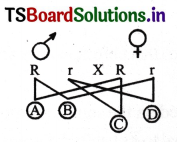
Find out the phenotype of A, B, C, D from the given cross in Snapdragon (R = red and r= white).
1. A-Red, B-Pink, C-Pink, D-White
2. A-Red, B-Red, C-White, D-White
3. A-Pink, B-Red, C-White, D-White
4. A-Pink, B-Red, C-Red, D-White
Answer:
1. A-Red, B-Pink, C-Pink, D-White
Question 7.
How many phenotypes and genotypes are possible in ABO blood group systems
1. Four, five
2. Four, six
3. Four, seven
4. Three, four
Answer:
2. Four, six
Question 8.
Starch synthesis gene in pea plant is an example of
1. single gene produces more than one effect
2. multiple genes produce more than one effect
3. two genes produce more than one effect
4. multiple genes produce less than one effect
Answer:
1. single gene produces more than one effect
Question 9.
Match the following columns.
| Column – I | Column – II |
| A) Test cross | 1. 9: 3 : 3: 1 |
| B) Monohybrid cross | 2. Tt × ft |
| C) F1 selfing | 3. Tt × Tt |
| D) Dihybrid cross | 4. 3:1 |
A B C D
1) 2 4 3 1
2) 2 4 1 4
3) 3 4 1 2
4) 1 4 1 3
Answer:
1) 2 4 3 1
Question 10.
The types of gametes formed by the genotype RrYy are
1. RY, Ry, rY, ry
2. RY, Ry, ry, ry
3. Ry, Ry, Yy, ry
4. Rr, RR, Yy, YY
Answer:
1. RY, Ry, rY, ry
Question 11.
What is the genotypic ratio in Mendel dihybrid cross?
1. 1 : 2 : 2 : 4 : 1 : 2 : 1 : 2 :1
2. 1 : 4 : 1 : 1 : 2 : 1 : 1 : 2 : 1
3. 1 : 4 : 2 : 1 : 1 :1 : 2 : 1
4. 4 : 2 : 1 : 1 : 1 : 1 : 2 : 1 : 1
Answer:
1. 1 : 2 : 2 : 4 : 1 : 2 : 1 : 2 :1
Question 12.
Strength of the linkage between the two genes is
1. proportionate to the distance between them
2. inversely proportionate to the distance between them
3. depending on length of the chromosomes
4. depending on size of the chromosomes
Answer:
2. inversely proportionate to the distance between them
II. Fill in the Blanks
1. The cross between parents, which differ in two pairs of contrasting characters, is ………………….. .
Answer:
Dihybrid cross
2. Mendel selected …………………………. true-breeding pea plant varieties, as pairs which were similar except for one character with contrasting traits.
Answer:
14
3. The production of gametes by the parents, the formation of the zygotes, the F1 and F2 plants can be understood from a diagram is called ………………………… .
Answer:
Punnett Square or Checkerboard.
4. The inheritance of flower colour in ……………….. is a good example to understand incomplete dominance.
Answer:
Dog flower (snapdragon or Antirrhinum)
5. The first genetic map of a chromosome was constructed by ……………………….. .
Answer:
Alfred Sturtevant.
6. The phenotypic ratio of Snapdragon plant monohybrid cross in F2 generation is ………………….. .
Answer:
1: 2: 1
7. The crossing of F1 with its recessive parent is called ……………………….. .
Answer:
Test Cross
8. Linked genes are present on the …………………………….. .
Answer:
Same Chromosome
III. One Word Answer Questions
Question 1.
On which plant did Mendel carry out his experiments?
Answer:
Garden pea (Pisum sativum).
Question 2.
Who is called the Father of Genetics?
Answer:
G. J. Mendel
Question 3.
What is the phenotypic ratio of F2 in a dihybrid cross?
Answer:
9 : 3 : 3: 1
Question 4.
What is the genotypic ratio of F2 in a monohybrid cross?
Answer:
1:2:1
Question 5.
What is meant by a physically expressed external character of an individual?
Answer:
Phenotype
Question 6.
What is known as having two similar alleles for a particular trait?
Answer:
Homozygous
Question 7.
What is the term used for the discrete units that govern inheritance of characters?
Answer:
Factors
Question 8.
Mention one cross in which the phenotypic ratio is the same as the genotypic ratio in the F generation.
Answer:
Incomplete dominance or Co-dominance.
Objective Questions
Question 1.
Genes responsible for a pair of opposite traits are known as
1. Hybrids
2. Factors
3. Purehnes
4. Alleles
Answer:
4. Alleles
Question 2.
The dwarf character appears
1. Only after selfing the F1 hybrids
2. Only in F1 generation
3. After crossing F1 hybrids with the dominant parent
4. Only in F2 generation
Answer:
1. Only after selfing the F1 hybrids
Question 3.
In Snapdragon, inheritance of flower colour demonstrates
1. Complete dominance
2. Incomplete recessiveness
3. Incomplete dominance
4. Complete recessiveness
Answer:
3. Incomplete dominance
Question 4.
The Law of Independent Assortment is best explained by
1. Test cross
2. Dihybrid cross
3. Monohybrid cross
4. Backcross
Answer:
2. Dihybrid cross
Question 5.
In Drosophila, the genes controlling body colour and eye colour are located on
1. Sex chromosome
2. X chromosome
3. Autosomes
4. Y chromosome
Answer:
3. Autosomes
Question 6.
The chromosome mapping technique was introduced by
1. Alfred Sturtevant
2. Franklin Stahl
3. Marshall Nirenberg
4. Alfred Hershey
Answer:
1. Alfred Sturtevant
Question 7.
A point mutation refers to
1. Loss of chromosome segments
2. Addition of new chromosome segments
3. Change in a single DNA base pair
4. Alteration of an entire chromosome set
Answer:
3. Change in a single DNA base pair
Question 8.
Sickle-cell anaemia results from
1. Polyploidy
2. Single base alteration
3. Insertion
4. Deletion
Answer:
2. Single base alteration
Question 9.
In agriculture, mutations are useful for
1. Development of improved varieties
2. Weed control
3. Pest control
4. Pathogen control
Answer:
1. Development of improved varieties
Question 10.
Which of the following traits in pea plants is recessive?
1. Tall plants
2. Yellow-coloured pods
3. Round seeds
4. Axial flowers
Answer:
2. Yellow-coloured pods
Question 11.
The fastest method of generating genetic variation in crop plants is
1. Polyploidy
2. Hybridization
3. Mutation
4. Selfing
Answer:
3. Mutation
Question 12.
The major chemical basis of heredity in living organisms is
1. Protein
2. DNA
3. Enzyme
4. RNA
Answer:
2. DNA
Question 13.
Genetic information is stored in DNA instead of RNA because
1. DNA is more stable
2. DNA is double-stranded
3. DNA can replicate
4. DNA has higher molecular weight
Answer:
1. DNA is more stable
Question 14.
Genomics is a modern branch concerned with
1. Study of genes
2. Artificial synthesis of genes
3. Transfer of hereditary information
4. Study of the nucleotide sequence of the human genome
Answer:
4. Study of the nucleotide sequence of the human genome
Question 15.
Identify the correct statement
1. Variations are caused only by mutations
2. Hereditary material in all organisms is DNA
3. Genes are randomly arranged on chromosomes
4. RNA is a highly stable nucleic acid
Answer:
2. Hereditary material in all organisms is DNA
Question 16.
The fundamental unit of inheritance is
1. DNA
2. Chromosome
3. Gene
4. Nucleus
Answer:
3. Gene
Question 17.
Mutations bring changes in
1. Genotype only
2. Phenotype only
3. Chromosomes only
4. Both genotype and phenotype
Answer:
4. Both genotype and phenotype
Question 18.
Mutations do not lead to
1. Variations
2. Cancer
3. Changes in gene sequences
4. Denaturation of DNA molecule
Answer:
4. Denaturation of DNA molecule
Question 19.
Transgenic crops are produced through
1. Hybridization
2. Gene transfer
3. Gene sequencing
4. Induced mutations
Answer:
2. Gene transfer
Question 20.
Variation and recombination mainly arise due to
1. Cytokinesis
2. Crossing over
3. Synapsis
4. Disjunction of genomes
Answer:
2. Crossing over
Question 21.
Linked genes can be separated naturally through
1. Mutation
2. Genetic engineering
3. Crossing over
4. Genomics
Answer:
3. Crossing over
Question 22.
Which one of the following is NOT a characteristic of genetic material?
1. It should be able to mutate
2. It should replicate itself
3. It is chemically more reactive
4. It must be stable
Answer:
3. It is chemically more reactive
Question 23.
Among the following, which acts as the genetic material?
1. Histone
2. DNA
3. Protein
4. Non-histone
Answer:
2. DNA
Question 24.
Mutations are
1. Non-heritable changes
2. Heritable alterations in characters
3. Changes only in chromosome number
4. Changes only in chromosome shape
Answer:
2. Heritable alterations in characters
Question 25.
Parental characters appear in offspring because of
1. Recombinations
2. Mutation
3. Linkage
4. Crossing
Answer:
3. Linkage
Question 26.
A true-breeding plant is one that
1. Is always homozygous recessive
2. Produces offspring by selfing and remains homozygous
3. Breeds on its own
4. Is produced by selfing a heterozygous plant
Answer:
2. Produces offspring by selfing and remains homozygous
Question 27.
Normally, a gamete contains
1. Many alleles of a gene
2. One allele of a gene
3. All alleles of a gene
4. Two alleles of a gene
Answer:
2. One allele of a gene
Question 28.
Mendel proposed that stable units passed from parents to offspring are called
1. Genes
2. Alleles
3. Factors
4. Genotype
Answer:
3. Factors
Question 29.
In a dihybrid cross, the maximum number of phenotypes that can be obtained is
1. 8
2. 16
3. 4
4. 2
Answer:
3. 4
Question 30.
The numbers of genotypes and phenotypes, respectively, in the F2 generation of a Mendelian dihybrid cross are
1. 4 & 9
2. 9 & 4
3. 8 & 16
4. 9 & 12
Answer:
2. 9 & 4
Question 31.
What is the phenotypic ratio obtained in a dihybrid test cross?
1. 9 : 3 : 3: 1
2. 1: 1: 1: 1
3. 2: 1: 1
4. 1 : 2 : 2 : 4 : 1 : 2 : 1 : 2 : 1
Answer:
2. 1: 1: 1: 1
Question 32.
A cross between two pea plants with round seeds produced some wrinkled-seeded offspring. The parental genotypes must be
1. RR & RR
2. RR & Rr
3. Rr & Rr
4. RR & rr
Answer:
2. RR & Rr
Question 33.
A change occurring in a single base pair of DNA is known as
1. Silent mutation
2. Point mutation
3. Frame-shift mutation
4. Lethal mutation
Answer:
2. Point mutation
Question 34.
A well-known example of a point mutation is
1. Turner’s syndrome
2. Down’s syndrome
3. Sickle-cell anaemia
4. Acquired Immunodeficiency Syndrome
Answer:
3. Sickle-cell anaemia
Question 36.
If all F1 plants are tall and the F2 generation shows a 3 tall: 1 dwarf ratio, it supports
1. Law of Dominance
2. Law of Segregation
3. Law of Independent Assortment
4. Incomplete Dominance
Answer:
2. Law of Segregation
Question 37.
In the F2 generation, both phenotypic and genotypic ratios are 1: 2 :1 in
1. Codominance
2. Incomplete dominance
3. Test cross
4. 1 & 2
Answer:
4. 1 & 2
Question 38.
In a monohybrid cross, F1 hybrids produce two types of gametes carrying one character each. This illustrates
1. Alleles
2. Heterozygous condition
3. Purity of gametes
4. Inherited factor
Answer:
3. Purity of gametes
Question 39.
When a heterozygous tall plant is crossed with a homozygous dwarf plant, the progeny shows
I) 1: 1 phenotypic ratio
II) 1: 1 genotypic ratio
III) No recessive individuals
IV) No dominant individuals
1. I & II
2. I & IV
3. I & III
4. III & IV
Answer:
1. I & II
Question 40.
The diagrammatic tool used to visualize all possible combinations of male and female gametes is called
1. Morgan square
2. Punnett square
3. Bateson square
4. Mendel square
Answer:
2. Punnett square
Question 41.
A cross between an organism showing a dominant trait and another with a known recessive phenotype is called
1. Back cross
2. Reciprocal cross
3. Test cross
4. Progeny test
Answer:
3. Test cross
Question 42.
In a typical monohybrid cross, the percentage of F2 offspring resembling the dominant parent phenotypically is
1. 25
2. 75
3. 50
4. 100
Answer:
2. 75
Question 43.
The Mendelian phenotypic ratio of 9 :3 : 3: 1 is explained by
1. Law of Dominance
2. Law of Segregation
3. Law of Purity of Gametes
4. Law of Independent Assortment
Answer:
4. Law of Independent Assortment
Question 44.
How many different types of gametes can be produced by a plant with genotype Yy rrTt?
1. Two
2. One
3. Four
4. Eight
Answer:
3. Four
Question 45.
The famous paper “Experiments on Plant Hybrids” was published in
1. 1866
2. 1856
3. 1863
4. 1906
Answer:
4. 1906
Question 46.
Gene → ⊗ → Character. Identify X.
1. Toxin
2. Hormone
3. Vitamin
4. Enzyme
Answer:
4. Enzyme
Question 47.
The 3: 1 proportion observed in the F3 generation is explained by
1. Law of Segregation
2. Law of Dominance
3. Test Cross
4. Law of Independent Assortment
Answer:
1. Law of Segregation
Question 48.
When both alleles express their effects simultaneously in a heterozygote, the phenomenon is known as
1. Dominance
2. Codominance
3. Pseudodominance
4. Amphidominance
Answer:
2. Codominance
Question 49.
Which one of the following represents a test cross?
1. YyRr × yyrr
2.YYRR × yyrr
3.YyRr × YyRr
4.YyRr × YYYR
Answer:
1. YyRr × yyrr
Question 50.
A test cross is mainly carried out to determine the
1. Phenotype of hybrid
2. Genotype of hybrid
3. Genotype of recessive parent
4. Genotype of dominant parent
Answer:
4. Genotype of dominant parent
Question 51.
No phenotypic change occurs when an altered gene produces
1. No enzyme
2. Functional enzyme
3. Less efficient enzyme
4. Non-functional enzyme
Answer:
4. Non-functional enzyme
Question 52.
Pleiotropy is correctly represented as
1. One gene → one phenotype
2. One phenotype → different genotypes
3. One gene → different phenotypes
4. Many genes → one phenotype
Answer:
3. One gene → different phenotypes
Question 53.
Phenotypic and genotypic ratios differ in
1. Monohybrid cross F2
2. Monohybrid Test Cross
3. Codominance F2
4. Incomplete Dominance F2
Answer:
1. Monohybrid cross F2
Question 54.
The stage of meiosis during which chromosome segregation occurs is
1. Prophase I
2. Anaphase I
3. Prophase II
4. Anaphase II
Answer:
2. Anaphase I
Question 55.
Crossing over in diploid organisms is mainly responsible for
1. Dominance of genes
2. Linkage between genes
3. Recombination of linked genes
4. Segregation of alleles
Answer:
3. Recombination of linked genes
Question 56.
According to Mendelism, which of the following shows dominance?
1. Wrinkled seeds
2. Green seed coat colour
3. Green pod colour
4. Terminal flower position
Answer:
3. Green pod colour
Question 57.
In hybridization, Tt × tt produces offspring in the ratio
1. 3: 1
2. 1: 2: 1
3. 1: 1
4. 1: 2
Answer:
3. 1: 1
Question 58.
Multiple alleles are responsible for the Inheritance of
1. Phenylketonuria
2. Colour blindness
3. ABO blood groups
4. Sickle-cell anaemia
Answer:
3. ABO blood groups
Question 59.
The process that enables a gene to move from one linkage group to another is called
1. Duplication
2. Inversion
3. Crossing-over
4. Translocation
Answer:
4. Translocation
Question 60.
Fruit colour in squash is an example of
1. Recessive epistasis
2. Dominant epistasis
3. Complementary genes
4. Inhibitory genes
Answer:
2. Dominant epistasis