
Referring to the AP Inter 1st Year Maths Study Material Chapter 9 Straight Lines Exercise 9a Solutions makes it easier to understand complex problems.
AP Inter 1st Year Maths Straight Lines Solutions Exercise 9a
Question 1.
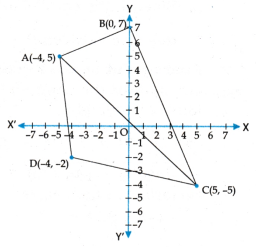
Draw a quadrilateral in the cartesian plane, whose vertices are (-4, 5), (0, 7), (5, -5) and (-4, -2). Also find its area.
Solution:
Let ABCD be the given quadrilateral with vertices A(-4, 5), B(0, 7), C(5, -5) and D(-4, -2). Then by plotting A, B, C and D on the cartesian plane and joining AB, BC, CD and DA.The given quadrilateral can be drawn as
To find the area of quadrilateral ABCD, we draw one diagonal, say AC.
Accordingly area (ABCD)=Area (ΔABC)+Area (ΔACD)
We know that the area of a triangle whose vertices are (x1, y1), (x2, y2), and (x3, y3) is given by
\(\frac{1}{2}\)|x1(y2 – y3) + x2(y3 – y1) + x3(y1 – y2)|
Therefore, area of
ΔABC = \(\frac{1}{2}\)|- 4(7 + 5) + 0(-5 – 5) + 5(5 – 7)| unit2
= \(\frac{1}{2}\)|- 4(12) + 5(-2)| unit2
= \(\frac{1}{2}\) |- 48 – 10 | unit2
= \(\frac{1}{2}\) × 58 unit2
= 29 unit2
Question 2.
The base of an equilateral triangle with side 2a lies along the Y-axis such that the mid point of the base is at the origin. Find the vertices of the triangle.
Solution:
Let ABC be the given equilateral triangle with side 2a.
Accordingly AB = BC = CA = 2 a
Assume that base BC lies along the Y-axis such that the mid-point of BC is at the origin,
i. e., BO = OC = a, where O is the origin.
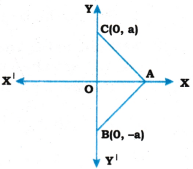
Now it is clear that the coordinates of point C are (0, a) while the coordinates of point B are (0, -a). It is known that the line joining a vertex at an equilateral triangle with the mid-point of its opposite side is perpendicular. Hence, vertex A lies on the X-axis.
On applying Pythagoras theorem to ΔAOC, we have (AC)2 = (OA)2 + (OC)2
(2a)2 = (OA)2 + a2
⇒ 4a2 – a2 = (OA)2
⇒ (OA)2 = 3a2
Coordinates of point A is (±√3a, 0).
Thus the vertices of the given equilateral triangle are
(0, a)(0, -a) and (√3a, 0) (or) (0, a)(0, -a) and (-√3a, 0)
Question 3.
Find the distance between P(x1, y1) and Q(x2, y2) when
i) PQ is parallel to the Y-axis
ii) PQ is parallel to the X-axis.
Solution:
The given points are P(x1, y1) and Q(x2, y2)
i) When PQ is parallel to the Y-axis, x1 = x2 in this case, distance between P and Q
⇒ \(\sqrt{\left(x_2-x_1\right)^2+\left(y_2-y_1\right)^2}=\sqrt{\left(y_2-y_1\right)^2}\) = |y2 – y1|
ii) When PQ is parallel to the X-axis, y1 = y2, in this case, distance between P and Q ⇒ \(\sqrt{\left(x_2-x_1\right)^2+\left(y_2-y_1\right)^2}=\sqrt{\left(x_2-x_1\right)^2}\) = |x2 – x1|

Question 4.
Find a point on the X-axis, which is equidistant from the points (7, 6) and (3, 4).
Solution:
Let (a, 0) be the point on the X-axis that is equidistant from the points (7, 6) and (3, 4) accordingly
⇒ \(\sqrt{(7-a)^2+(6-0)^2}=\sqrt{(3-a)^2+(4-0)^2}\)
⇒ \(\sqrt{49+a^2-14 a+36}=\sqrt{9+a^2-6 a+16}\)
⇒ \(\sqrt{a^2-14 a+85}=\sqrt{a^2-6 a+25}\)
Squaring on both sides, we have
a2 = 14a + 85 = a2 – 6a + 25
⇒ -14a + 6a = 25 – 85
⇒ -8a = -60
⇒ a = \(\frac{60}{8}=\frac{15}{2}\)
Thus, the required point on the X-axis is (\(\frac{15}{2}\), 0).
Question 5.
Find the slope of a line, which passes through the origin, and the mid-point of the line segment joining the points P(0, -4) and B(8, 0).
Solution:
The coordinates of the mid-point of the line segment joining the points P(0, -4) and B(8, 0) are \(\left(\frac{0+8}{2}, \frac{-4+0}{2}\right)\) = (4, -2)
It is known that the slope (m) of a non-vertical line passing through the points (x1, y1) and (x2, y2) is m = \(\frac{y_2-y_1}{x_2-x_1}\), x2 ≠ x1
Therefore, the slope of the line passing through (0, 0) and (4, -2) is
= \(\frac{-2-0}{4-0}=\frac{-2}{4}=-\frac{1}{2}\)
Hence, the required slope of the line is –\(\frac{1}{2}\).
Question 6.
Without using the Pythagoras theorem, show that the points (4, 4), (3, 5) and (-1, -1) are the vertices of a right angled triangle.
Solution:
Let the given points be A(4, 4), B(3, 5) and C(-1, -1)
Slope of \(\overline{A B}=\frac{y_2-y_1}{x_2-x_1}=\frac{5-4}{3-4}\) = -1
Slope of \(\overline{\mathrm{AC}}=\frac{\mathrm{y}_2-\mathrm{y}_1}{\mathrm{x}_2-\mathrm{x}_1}=\frac{-1-4}{-1-4}\) = 1
Slope of \(\overline{\mathrm{AB}}\) × slope of \(\overline{\mathrm{AB}}\) = -1
∴ AB and AC are perpendicular
∴ ΔABC is a right angled triangle
Question 7.
Find the slope of the line, which makes an angle of 30° with the positive direction of Y- axis measured anti — clockwise.
Solution:
If a line makes an angle of 300 with the positive direction of the Y—axis measured anti-clockwise, then the angle made by the line with the positive direction of the
X-axis measured anti-clockwise is 90° + 30° 120°
Thus the slope of the given line is tan 120° = tan(180° – 60°) = – tan 60° = -√3
Question 8.
Without using distance formula, show that points (-2, -1). (4, 0), (3, 3) and (-3, 2) are the vertices of a parallelogram.
Solution:
Let the points be A (-2, -1), B (4, 0), C (3, 3) and D (-3, 2).
Slope of AB = \(\frac{0+1}{4+2}=\frac{1}{6}\) = and Slope of CD = \(\frac{2-3}{-3-3}=\frac{-1}{-6}=\frac{1}{6}\)
⇒ Slope of AB = Slope of CD ⇒ AB and CD are parallel to each other.
⇒ Slope of BC = Slope of AD ⇒ BC and AD are parallel to each other.
Now, slope of BC = \(\frac{3-0}{3-4}=\frac{3}{-1}\) = -3 and Slope of AD = \(\frac{2+1}{-3+2}=\frac{3}{-1}\) = -3
Therefore, both pairs of opposite sides of a quadrilateral ABCD are parallel. Hence ABCD is a parallelogram.
Thus, points (-2, -1), (4, 0), (3, 3) and (-3, 2) are the vertices of a parallelogram.
Question 9.
Find the angle between the X-axis and the line joining the points (3, -1) and (4, -2).
Solution:
The slope of the line joining the points (3, -1) and (4, -2) is m = \(\frac{-2-(-1)}{4-3}\) = -1
Now, the inclination (θ) of the line joining the points (3, -1) and (4, -2) is given by tan θ = -1
⇒ θ = (180° – 45°) = 135°
Thus, the angle between the X-axis and the line joining the points (3, -1) and (4, -2) is 135°.
Question 10.
The slope of a line is double of the slope of another line. If tangent of the angle between them is 1/3, find the slopes of the lines.
Solution:
Let m1 and m are the slopes of the two given lines such that m1 = 2m.
We know that 0 is the angle between the lines l1 and l2 with slopes m1 and m2 then
tan θ = \(\left|\frac{m_1-m_2}{1+m_1 m_2}\right|\)
It is given that the tangent of the angle between the two lines is 1/3.
\(\frac{1}{3}=\left|\frac{2 m-m}{1+(2 m) m}\right|\)
⇒ \(\frac{1}{3}=\left|\frac{m}{1+2 m^2}\right|\)
⇒ \(\frac{1}{3}=\frac{\mathrm{m}}{1+2 \mathrm{~m}^2}\)
(or)
\(\frac{1}{3}=-\left(\frac{m}{1+2 m^2}\right)=\frac{-m}{1+2 m^2}\)
Case I:
\(\frac{1}{3}=\frac{\mathrm{m}}{1+2 \mathrm{~m}^2}\)
⇒ 2m2 + 1 = 3m
⇒ 2m2 – 3m + 1 = 0
⇒ 2m2 – 2m – m + 1 = 0
⇒ 2m(m – 1) – 1(m – 1) = 0
⇒ (m – 1)(2m – 1) = 0
⇒ m = 1 or m = -½
If m = 1, then m1 = 2m = 2(1) = 2
If m = -½, then m1 = 2(½) = 1
Case II:
\(\frac{1}{3}=\frac{-m}{1+2 m^2}\)
⇒ 2m2 + 2m + m + 1 = 0
⇒ 2m(m + 1) + (m + 1) = 0
⇒ (m + l).(2m + 1) = 0
⇒ m = -1 (or) m = -½
If m = -1, then m1 = 2m = 2 (-1) = – 2
If m = -½, then m2 = 2m = 2 (-½) = – 1
Hence the slopes of the lines are 1 and 2 or ½ and 1; -1 and -2 or -½ and -1.
Question 11.
A line passes through (x1, y1) and (h, k). If slope of the line is m, show that k – y1 = m (h – x1).
Solution:
The slope of the line passing through (x1, y1) and (h, k) is \(\frac{k-y_1}{h-x_1}\) .
It is given that the slope of the line is m.
∴ \(\frac{k-y_1}{h-x_1}\) = m ⇒ k – y1 = m(h – x1).
Hence, k – y1 = m(h – x1).